Wednesday, May 31, 2006
CNN's Arwa Damon in Haditha
Tonight's Anderson Cooper 360 broadcast a segment with embedded reporter Arwa Damon, in which she rebroadcast a segment she filmed in Haditha last October, shortly before the massacre (or "Massacre?" to use CNN's description) which has the world's attention at the moment. The segment praised the Marines Damon was with for their "restraint," describing for example an episode in which she and they were pinned down on a rooftop, taking fire for hours, but "they never fired a shot back" because they couldn't pinpoint the source of the fire. Finally, according to Damon, they identified (or thought they had identified) the source. And what did these "restrained" Marines do? Position a sniper to take out the attacker? No, they called in a tank which fired a shell at the suspected house, demolishing it. And then, the most amazing thing happened. Streams of injured civilians came pouring out of the house, and it didn't change Damon's opinion of the "restraint" at all! And, with scores of civilians coming out of this recently destroyed house, Damon didn't even ask the obvious question: was anyone killed when this tank shell ripped the house apart? It certainly seems likely that they were, but we'll never know from this piece.
The "rules of engagement" of the U.S. military, as illustrated by this episode, last week's massacre in Kandahar, or countless other examples, couldn't be clearer. If the U.S. military even thinks that a suspected enemy fighter is inside a building, they consider that they have the right to simply destroy that building, without even asking the question of who might be inside, much less actually attempting to find out. This is because the slightest risk to the life of one American soldier is evidently considered to outweigh a much more concrete risk to almost any number of innocent civilians (as long as those civilians are those barely-qualifying-as-human "foreigners" without, as far as we know, names, families, or emotions).
Remembrances of Haditha
Here are two stories from 2005, which bear directly on the current story of the Haditha massacre and its exposure in the press.
First, this one from March, 2005: "US occupation forces' fighter planes have attacked civilian populations in the Iraqi cities of Haditha and Haqlaniyah, in the western province of Al Anbar." This story, as far as I could tell at the time, never appeared in a single corporate news outlet. The old tree falling the forest story. Iraqi civilians are massacred on the ground and from the air by American forces on a routine basis; only the rare stories even make the press for a one-day run, and few indeed get the followup they really deserve.
And, most significantly, this story from August, 2005, which ominously presages the massacre which would occur that November:
Talking to a truckload of troops, sitting in pre-dawn darkness Friday morning, Sgt. Marcio Vargas Estrada made the point to the men of his squad from 3-2's Lima Company.Was the massacre in Haditha a case of a few bad apples suddenly going rotten? Hardly. Some of them were bragging about it in advance three months earlier.
"If somebody shoots at you, you waste him," said Estrada, 32, of Kearny, N.J. "When you go back to Camp Lejeune, these will be the good old days, when you brought . . . death and destruction to -- what . . . is this place called?"
A Marine answered in the darkness: "Haqlaniyah."
Estrada continued: "Haqlaniyah, yeah, that. And then we will take death and destruction to Hadithah. Hopefully, we'll stay until December so we can bring death and destruction to half of . . . Iraq."
The flatbed truck erupted in a storm of "Hoo-ahs."
As I wrote then: "Support the troops? Count me out."
Lightening the mood
In an attempt to avoid a continuous string of news of death and destruction, here's another one of my vacation photos:

Killdeer, photographed at Carmel River State Beach
Actually the most interesting thing about this picture is something you really can't see--there are two Killdeer in this picture, the parent (could be male or female, appearance and behavior pretty much indistinguishable) and a tiny chick, which only became apparent when they both stood up and walked around. The chick is visible in a small "hole" in the sticks, in a box below the parent formed by two light-colored thin sticks (top and left) and two darker larger sticks (bottom and right), where you can see a black-white--gray pattern which is the chick's face.
Anyway, one of my favorite birds, partly because they're so easy to identify for a birder of decidedly modest abilities like myself, thanks to their distinctive markings (and sounds). And, I thought, a fairly nicely-composed shot. Enjoy. We'll be back to the death and destruction soon enough. Come to think of it, "Killdeer" isn't exactly a peaceful name, is it?
Another in a long line of checkpoint shootings
It's happened again. "It" isn't another checkpoint shooting in Iraq, "it" is the fact that it's one of those rare ones that actually got reported:
U.S. forces killed two Iraqi women--one of them about to give birth--when the troops shot at a car that failed to stop at an observation post in a city north of Baghdad, Iraqi officials and relatives said Wednesday.Before I go any further, let me say that, in the light of the recent injury of CBS reporter Kimberly Dozier, I am not blaming the media for the fact that stories like this don't get reported. The responsibility lies entirely with the U.S. military, who without question are the recipients of internal reports on every such incident, but routinely "roundfile" them or otherwise just keep them quiet.
Back to this story. Let me start by repeating a post from last March:
How common are "checkpoint" shootings like that of Giuliana Sgrena which has made the news? This from AP:Which brings us back to the "dueling stories" from today's murder. From the U.S. military:"Yarmouk hospital - just one of several large medical facilities in Baghdad - receives several casualties a day from such shootings, said Dr. Mohamed Salaheddin."And, to no one's surprise:"Shooting deaths of Iraqi civilians are so common they're rarely reported in the media."The blood-splattered little girl whose picture appears at the top of this page? If an embedded reporter hadn't been accompanying the patrol which killed her parents and left her and her five brothers and sisters orphans, the chances that you (or I) would have ever learned of her story are slim and none.Say it with me now. Out Now! When you are occupying a country and your "soldiers carry signs asking people to stay away," isn't that about as clear a sign as possible that you don't belong there?
The U.S. military said coalition troops fired at a car after it entered a clearly marked prohibited area near an observation post but failed to stop despite repeated visual and auditory warnings.And from the driver, who lived:
"Shots were fired to disable the vehicle," the military said in a statement e-mailed to The Associated Press.
Jassim's brother, who was wounded by broken glass, said he did not see any warnings as he sped his sister to the hospital. Her husband was waiting for her there.Which brings us back to the murder of Nicola Calipari, riding in a car with Italian journalist Giuliana Sgrena. I analyzed then the fiction that the U.S. troops could have possibly fired any kind of warning shots in a manner timely enough to have allowed the car to stop before they fired their deadly shots. And now in this case, we have the claim that "shots were fired to disable the vehicle." Wouldn't that require shooting either the tires or the driver, rather than the occupants? And take a look at this picture from AP, which is from the site of the hospital to which the car was en route:
"I was driving my car at full speed because I did not see any sign or warning from the Americans. It was not until they shot the two bullets that killed my sister and cousin that I stopped," he said.

If this is the kind of "warning" sign that the U.S. troops are posting and expecting drivers to stop for, it's no wonder Iraqis are being shot every day as a result. I can barely read the top line in the sign in this picture, which appears to have been taken from about 20 feet away from the sign. Imagine trying to read a sign like this from a speeding car, at a distance far enough away to allow stopping the car!
The names are different in today's murders. The conclusion is the same. Out Now!
Recommended reading: immigration
Knowledge of history is always helpful to understanding the present. In this regard, I'd like to recommend two articles I've come across recently. The first is an article in the latest issue of Socialism and Liberation magazine, written by Professor Ron Wilkins of California State Univeristy. The article explores the Mexican-American war (which resulted in half of Mexico being annexed by the United States), slavery, and, in those contexts, the relationship between Blacks and Mexicans. You'll learn things like this:
From 1825 until the end of the Civil War in 1865, Mexican authorities continuously thwarted attempts by slave-holding Texas settlers to conclude fugitive slave extradition treaties between the two parties. During this period of extremely tense relations between the two governments, Mexico consistently repudiated and forbade the institution of slavery in its territory, while U.S. officials and Texas slave owners continuously sought ways to circumvent Mexican law.You'll learn about "Mexican General José Urrea and the land titles that he and his men granted to former Texas slaves following the defeat of the Alamo." And you'll learn about the history of slaves escaping to freedom in Mexico, and the earliest attempts of the U.S. government to militarize the U.S.-Mexico border:
By the year 1855, the estimates were that as many as 4,000 to 5,000 formerly enslaved Africans had escaped to Mexico. Slaveholders became so alarmed at this trend, that they requested and received, approximately one-fifth of the standing U.S. army, which was deployed along the Texas-Mexico border in a vain effort to stem the flow of runaways.Fascinating article.
The second article, which appeared in the Los Angeles Times, was written by Professor Mae N. Ngai of the University of Chicago. This article is focused on the history of U.S. immigration policy. In it, you'll learn things like:
There were so few restrictions on immigration in the 19th and early 20th centuries that there was no such thing as "illegal immigration." The government excluded a mere 1 percent of the 25 million immigrants who landed at New York's Ellis Island before World War I, mostly for health reasons.Or how hundreds of thousands of illegal immigrants -- mostly Europeans -- became legal:
- The Registry Act of 1929 allowed immigrants who arrived before 1921 but had no record of their admission to register retroactively, for a $20 fee.
- From 1935 to the late 1950s, to keep families together, tens of thousands of Europeans unlawfully in the United States were temporarily allowed to go to Canada and legally re-enter the States as permanent residents.
- In 1940, Congress authorized the suspension of orders of deportation in cases of hardship, which it defined as "serious economic detriment" to the immigrant's immediate family. The guidelines have become less generous, but the principle remains in the law.
- In 1965, the United States repealed racial restrictions against Southern and Eastern Europeans and Asians, but the 1965 law also imposed quotas for the first time on Western Hemisphere countries. That created illegal immigration from Mexico and Central America.
- The 1986 immigration reforms addressed the problem by legalizing nearly 3 million undocumented workers. It also called for increased enforcement -- which didn't stop illegal immigration; it just made it more dangerous.
American "diplomacy"
This is what we call "unclear on the concept":
"As soon as Iran fully and verifiably suspends its enrichment and reprocessing activities, the United States will come to the table with our EU-3 colleagues and meet with Iran's representatives."Shorter Condi: "We'll be glad to discuss our demands with Iran as soon as they agree to our demands."
- top American "diplomat," Secretary of State Condoleezza Rice
Of course, being CondoLIEzza, she couldn't help but accompany this absurdity with a series of bold statements in the service of the big lie:
"The Iranian government...is...pursuing nuclear weapons in defiance of the international community."As I have written before with respect to the question of Iraqi WMD, it is the declaration of certainty which is the ultimate big lie. If Rice had said "suspected pursuit of nuclear weapons" or the like, that would at least be defensible, despite the fact that no serious evidence has been made public which would justify such a claim, not to mention the convincing case that Iran has made in disavowing any such intentions. But, as with Iraqi WMD, it is no mere accident or slip of the tongue that such statements are made in the absolute. Because telling the American public "we think Iraq might have WMD" or "we think Iran might be pursuing nuclear weapons" isn't enough to whip the public into a sufficient state of anger to accept the resulting consequences (the invasion of Iraq, bombing or sanctions imposed on Iran).
And there's an interesting twist when it comes to Iran. Because as hard as it is to prove you don't have WMD, proving that you aren't pursuing them is even harder. Let's recall that George Bush has declared it unacceptable for Iran to even know how to make nuclear weapons. Which means that any Iranian reading a physics textbook, or just browsing the Internet, could be deemed to be "pursuing" nuclear weapons.
The trial of Saddam Hussein
I've raised questions about the extent of the razing of the orchards in Dujail, I've noted the irony of trying Saddam Hussein and the others for the arrest, trial, and execution of 148 people for an actual assassination attempt when many people think one of the reasons George Bush wanted to invade Iraq (with the resulting death of more than a hundred thousand people without benefit of trial) was to avenge the arguably non-existent assassination attempt on his father, and many people have taken note of the fact that the reason this particular case was chosen to start the string of trials was to convict and execute Saddam Hussein and eliminate the need for trials on other alleged crimes which might expose "inconvenient" facts about the collaboration of the United States in those crimes.
But even I didn't expect it was this bad:
Defense witnesses in Saddam Hussein's trial over the killings of Iraqi Shiite villagers claimed many of those allegedly executed were still alive and said the prosecution case was built on bribes.Of course these witnesses aren't necessarily telling the truth. But if they are, it would be a pretty interesting demonstration of either the chutzpah or the incompetence (or both) of the prosecution, a prosecution which has an Iraqi face but an American core underneath it.
Tuesday, May 30, 2006
Forecasting
Forecasting in business or similar endeavors is hard enough. What market share will a certain company have in 2008? How many of a certain product will be sold in 2010? How could you possibly know? It depends on a thousand factors, involving everything that company does between now and then, everything each one of their competitors does, what the economy itself does, and so on. Yet analysts do quite a lucrative business making exactly such forecasts, always making out that they know the future with remarkable certainty even when their past predictions have proven inaccurate.
How much more ludicrous, then, is a forecast like this:
The Pentagon report said the strength of insurgents aiming to drive U.S.-led foreign forces out of Iraq "will likely remain steady throughout 2006 but that their appeal and motivation for continued violent action will begin to wane in early 2007."Isn't it funny how the waning of the insurgency, or the decrease in American troop strength, is always six months away, no matter when you ask the question?
About those troop reductions in Iraq you've heard so much about?
Fuhgeddaboudit:
U.S. military commanders are moving about 1,500 troops from a reserve force in Kuwait into the volatile Anbar province in western Iraq to help local authorities establish order there.This kind of action, by the way, is the essence of the Murtha plan for "withdrawal," a clear demonstration of why it is no such thing.
Wondering where all the money is?
This should help clear things up:
The industrial companies that make up the Standard & Poor's 500 index -- which excludes financial, transportation and utility companies -- have $643 billion in cash and equivalents.Is this a good thing? Don't be silly:
One of the biggest ways that companies have spent this excess money has been through mergers and acquisitions.And we all know what mergers and acquisitions lead to--layoffs.
Depersonalizing murder
Headline in the New York Times:
Not "killed." Just "dead." As if their demise had occured from old age, or natural causes like an earthquake.Anti-U.S. Rioting Erupts in Kabul; at Least 14 Dead
The article does its best to reinforce the headline. The first paragraph quite literally treats the riot as if it were an earthquake or a brush fire:
A deadly traffic accident caused by a United States military convoy quickly touched off a full-blown antiAmerican riot on Monday that raged across much of the Afghan capital, leaving at least 14 people dead and scores injured.The second paragraph provides the American cover story: "the United States military said only that warning shots had been fired in the air." Not until the sixth paragraph do we get the rebuttal to that spin, which comes from the actual facts:
It became clear the American military and the Afghan police and army had used their weapons to try to disperse the crowds. Scores of people were treated in hospitals for gunshot wounds.But even that is quickly forgotten. The very next paragraph interviews a doctor and talks about the actual dead people, but fails to mention how they died, leaving the thought that, although "scores were treated for gunshot wounds," perhaps the actual deaths were due to being trampled by a crowd or something else.
Fourteen people didn't just "die" in Afghanistan. They were killed by U.S. and/or Afghan troops.
Meanwhile, in the actions which are actually acknowledged as "killing," yet another air strike today in southern Afghanistan killed another 50 alleged Taliban, bringing the death toll from such attacks in just the last two weeks to more than 420. How many of those were actually Taliban, and how many innocent civilians, will surely never be known.
Monday, May 29, 2006
Remembering the dead. ALL the dead.
Memorial Day in the U.S. is officially a commemoration for members of the American military who have died in combat, so perhaps I could have forgiven a one-day omission of any other victims of American wars. But this, a sidebar (not online) to an column in the San Jose Mercury News about the "horror of war," was simply unforgiveable:
So now Iraqis and Afghans and all the other victims of U.S. aggression aren't even worth remembering, they aren't even human.The War's Human Toll
2,466
Number of U.S. soldiers killed in Operation Iraqi Freedom as of May 26
More than 18,000
The number of U.S. military members wounded
How much better if the American people used this day to remember all those victims: more than 100,000 fatalities from the invasion of Iraq, including not just those 2,466 American soldiers, but 224 soldiers from allied countries, and the Iraqi civilians, military (former and current), police, and resistance fighters whose numbers can only be estimated. 378 coalition fatalities (including 296 Americans) resulting from the invasion of Afghanistan, at least 3,500 Afghan civilians (as of the end of 2001!) who, it is worth remembering, had a lot less to do with the composition and actions of their own government than did the nearly 3,000 innocent Americans who died on Sept. 11, 2001, and thousands of Taliban fighters who, whatever their reactionary religious ideas, died legitimately defending their country from an illegal foreign invasion.
And there are others we should remember. The estimated one million Iraqis, the majority children, who died from the effect of a blockade which continued long after its alleged purpose, the destruction of Iraqi WMD, had been accomplished. The hundreds if not thousands of Iraqis who were killed by years of bombing on the U.S.-U.K. imposed "no-fly" zones, bombing which is now acknowledged as having been used to "soften up" Iraq for the coming invasion. And let's not forget the North Koreans, Iranians, and others, who have died from lack of health care or proper nutrition because their governments had to divert precious resources to defend against the very real threat of attack by the United States.
No doubt there are others I've forgotten in this brief summary. The cost of imperialism is high indeed.
Update: Already, just minutes after writing the above, this story about the death of a CBS camera crew in Baghdad reminds me of a group I left out--the hundreds of non-Iraqi (or Afghan) civilians who have died in Iraq and Afghanistan, including reporters, contractors (real ones, not just mercenaries), and others.
Update 2: Here's another group to remember: the spouses and others who have been murdered by soldiers returning from the war with their minds seriously tormented by their experiences. Not to mention the ones who have "merely" taken their own lives.
Update 3: And how could I forget the tens of thousands of Americans who have died due to lack of adequate health care, because war spending means that we "can't afford" such "luxuries."
Update 4: I meant to say somewhere at the start that I was limiting my listing to wars the U.S. is currently involved in. Clearly the list would be a lot longer and the numbers a lot bigger if I were to go back further, headed up by the nearly 1.5 million American and Vietnamese dead from the Vietnam War.
Sunday, May 28, 2006
Data mining
Data mining and surveillance are certainly important issues, but they're not "my" issue, so this will be a short post. I just wanted to alert interested readers to this article from "The Newspaper of Silicon Valley," the San Jose Mercury News. It's all about the technology involved, and about, among other things, software that can sift through every Internet packet passing through a hub, reassemble them into their original form including e-mail, files, or phone calls, and then analyze them. If the subject interests you, the article will.
One warning. Here in the U.S. it's Memorial Day weekend, and a certain kind of activity is very common. But folks, when you mail out email invitations to your friends to invite them to your party, be careful of what words you use:
For example, "if a terrorist is planning a bombing, they might say 'Let's have a barbecue,'" said Norris. "The software can detect if the word 'barbecue' is being used more often than usual."Oops. I just used the word twice! And, so did each of you as you read this post! Quick, hide!
Sometimes a cigar is just a cigar. Sigmund Freud (!) said that. Sometimes "a cigar" is a false positive. I said that (stealing from Bob Dylan's Talkin' World War III Blues).
Saturday, May 27, 2006
More terrorists loose in the U.S.
Listening to this talk by Gloria La Riva on events in Venezuela opened my eyes to the fact that there are terrorists other than Luis Posada Carriles whom the U.S. is refusing to extradite to Venezuela to be tried. The case is discussed at length here but here's a summary: in February 2003, the Colombian and Spanish consulates in Caracas were bombed. These bombings were viewed as an attempt at inciting further political instability in a country that was in the midst of an oil industry shutdown meant to topple Venezuelan President Hugo Chavez. The two suspects in the case, Jose Antonio Colina and German Rodolfo Varela, fled (naturally) to Miami. They were eventually arrested, just like Posada, on immigration charges, and spent years in detention. In early May, however, they were released from detention, and are now free (on probation) to roam the streets of Miami (or elsewhere).
Using the same specious claim as in the Posada case, that the suspects would "most likely" be subject to torture in Venezuela, the U.S. is refusing to extradite the two to Venezuela for trial. As in the Posada case, however, international law obliges the U.S. to prosecute them for the crimes if they refuse to acknowledge the extradition request. Instead, these two men, almost certainly terrorists (although obviously not yet convicted), are walking free.
War on terror? Don't you believe it.
"Nobody was killed at Abu Ghraib"
Retired Brig. Gen. David M. Brahms is quoted in the Washington Post about the Haditha massacre (item below): "When these investigations come out, there's going to be a firestorm. It will be worse than Abu Ghraib -- nobody was killed at Abu Ghraib." I heard this exact same line--"nobody was killed at Abu Ghraib"--several times yesterday from various pundits and news anchors. This is absolutely untrue.
It seems that Brig. Gen. Brahms, as well as the media, have forgotten all about Manadel al-Jamadi, who was not only tortured to death during interrogation at Abu Ghraib, but even features in a well-known picture of Charles Graner, one of those infamous Abu Ghraib "bad apples":

Nor was al-Jamadi the only Iraqi to die at Abu Ghraib. There are many others, including a number listed as "shot during riot," but many others listed as "natural causes or accident" or "unknown or still under investigation," many of which are quite likely to have actually been murders which were either covered up or simply never investigated.
Not that the killing has been limited to Abu Ghraib, of course. There was Abed Hamed Mowhoush, the Iraq General who was tortured to death by being stuffed in a sleeping bag head first and having someone sit on his chest. He just happens to have been killed at another Iraqi prison facility, Al-Qaim. Why, someone was even convicted in that murder. Although they called it "negligent homicide" and fined him a whopping $6,000.
Then there are those who never made it into a prison at all. There was Nazem Baji, executed by U.S. troops while in custody, shot in the head while his hands were tied with plastic handcuffs. There was Salem Hassan, beaten to death by U.S. soldiers at a checkpoint for refusing to remove a picture of Moqtada al Sadr from his car. And so many, many others.
"Nobody was killed at Abu Ghraib"? Bullshit.
Haditha: the "M" word hits the media
I was actually shocked to read the headline in the Washington Post: "In Haditha, Memories of a Massacre." 24 Iraqi civilians were killed in cold blood by U.S. Marines in Haditha last November, and for once this slaughter is being called by its right name: "massacre." Just last week, 16 Afghan civilians and a larger number of alleged Taliban fighters were killed by U.S. bombing in Kandahar, and not one corporate media source joined me in calling that a massacre, just as they wouldn't call the aerial murder of 45 people at an Iraqi wedding party a massacre either. Does it have to be a face-to-face confrontation, murder "in cold blood" before it qualifies as a "massacre"? Does that antiseptic, you can't see the whites of their eyes aerial bombing never qualify?
"Massacre" is, of course, a loaded word. In searching for stories with "Kandahar massacre" to see if anyone other than myself had called last week's events in Kandahar a massacre, I came across one of those "news roundup" articles in the Seattle Times. Consider this sequence of two stories:
Dili, East TimorSo when the Janjaweed, who are on the list of the "bad guys of the world," kill 100 unarmed people, it qualifies as a "massacre," but when East Timorese soldiers kill nine unarmed police, it doesn't.
Soldiers fired on unarmed police in East Timor's capital Thursday, killing nine and wounding 27.
...
Khartoum, Sudan
Sudanese cross-border raiders have massacred more than 100 villagers in Chad, Human Rights Watch alleged Thursday, expressing concern the violence in Darfur was spreading. Survivors told the New York-based group that the massacre was carried out last month by the Janjaweed.
Back in Haditha, we'll no doubt be revisiting the "few bad apples" theory to explain the murders. And certainly it's true that neither George Bush nor Donald Rumsfeld, nor even any medium-level commander in Iraq ordered this particular massacre. But that doesn't excuse this sentence in the Washington Post article: "Two U.S. military boards are investigating the incident as potentially the gravest violation of the law of war by U.S. forces in the three-year-old conflict in Iraq." No. The "gravest violation of the law of war" was the invasion of Iraq, the unproked assault on another country, the ultimate violation. Everything else follows from that.
"To initiate a war of aggression, therefore, is not only an international crime; it is the supreme international crime differing only from other war crimes in that it contains within itself the accumulated evil of the whole."
- Robert H. Jackson, chief prosecutor at the Nuremberg trials.
Friday, May 26, 2006
Dujail - searching for the facts
First posted 5/25/06, 8:41 p.m.[Important update - see below]
Following up on the post below, I've been doing a little more digging, and naturally finding more contradictions. Here's some of what I've found:
The only reference to "Dujail" in the New York Times prior to early 2005 is an article from March 29, 1991, written by Elaine Sciolino. I'm accessing it in PDF format via ProQuest, so I can't link to it, but here's what it says:
The Government also found other, more creative ways to punish Shiite dissent. In July 1982, for example, assassins tried to kill Mr. Hussein during a visit to the village of Dujail, a stronghold of Shiite militancy about 40 miles northeast of Baghdad. Mr. Hussein ordered the entire population deported and the village was razed.Aside from the curious assertion that an assassination attempt constitutes "dissent," note that there is no mention of 250,000 acres or orchards at all.
Now let's move forward to July 3, 2005, and the last major article in the Times on the subject, written by John F. Burns. Here's a portion of the narrative that Burns spins:
In small groups at first, then in larger roundups, about 1,500 townspeople were arrested, as many as 30 from single families, and started on a journey into Mr. Hussein's gulags.Earlier in the article, he has quoted a population figure of 75,000. So now we've gone from the more contemporaneous article in the Times claiming that "the entire population [was] deported and the village was razed" to arresting 1,500 people (2% of the town), and no mention of "razing the village" at all.
Burns also writes:
Within weeks, the razing of the palm groves and the orchards began, continuing until more than 250,000 acres had been bulldozed.Unfortunately, he provides no source for this information. Note also that, while recent articles refer only to 250,000 acres, Burns was claiming more than 250,000 acres.
There's something else in that article--a map of Iraq showing Dujail. I've extracted it, and made one small addition. That pink square you see centered on the town of Dujail? That's a square 20 miles on a side - 250,000 acres, the area allegedly razed by Saddam. Note that that square extends all the way to the nearest large town, Balad. Seeing it graphically like this makes clear just how implausible this claim is.
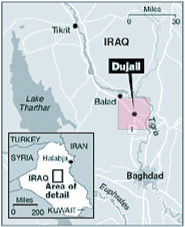
Update: John Burns replies:
BaghdadAs I noted in the previous post, this "fact" has been repeated hundreds of times (e.g., Wikipedia), never even including an "estimated," nevertheless an "alleged." Am I doubting that this happened at all? Of course not, it seems certain it did. I am pursuing this because it is, or may be, an object lesson in the way a "fact" can make it into the media and then be endlessly propagated, without anyone having checked the original source. In addition, it's an object lesson in how critical it is to question everything you read in the media, especially things that are said about "our enemies," because it is by unquestioningly believing such things that people are convinced that Iraq has WMD and ties to al Qaeda, Iran has plans for nuclear weapons, and in turn how wars are started and hundreds of thousands of people are killed.
May 26th 2006
Mr. Stephens:
This is a claim made by the prosecution at the trial -- in hectares, converted by us into acres. I'll ask the Regime Crimes Liaison Office to throw some light on this when I next meet with them.
Best regards
John Burns
John Fisher Burns
Bureau Chief
Baghdad Bureau
The New York Times
It is also well worth noting Burns' response to me in connection with his article of July 3, 2005, which reads like a documentary, laying out detail by detail what happened in Dujail. There is nothing, nothing, to suggest that the information in it includes allegations by the prosection, and everything which suggests that the narrative it weaves is simple, unchallenged historical fact, backed by the full weight of the New York Times.
Thursday, May 25, 2006
Bush, Blair, and "the people"
I didn't have the stomach to watch George Bush and Tony Blair's entire press conference, nor even to read the entire transcript. My hip boots aren't deep enough. In the part I did watch, however, one thing caught my attention:
Tony Blair: "the impression is given that the Iraqi people wish that we were gone from Iraq and weren't there any longer in support of the Iraqi government or the Iraqi forces. Not a single one of the people I talked to, not one of the political leaders, from whatever part of the spectrum in Iraq that I talked to -- and these are all people from all the different communities elected by their people -- not one of them wanted us to pull out precipitately. All of them wanted us to stick with it and see the job done."As was the case with Leslie Gelb in an article a year ago, the Prime Minister conflates (or confuses) the "Iraqi people" with the "political leaders." The fact, as an honest Blair would have admitted, is that all polls shows that the actual Iraqi people, the ones Blair isn't able to actually talk to since they aren't admitted to the Green Zone, in their vast majority want the Americans and British to leave. Needless to say, the "leaders," whose continuation in office and in the comfort of the Green Zone depends precisely on the presence of those troops, have a rather different opinion.
Bush makes the complementary error:
No question that the Iraq war has created a sense of consternation here in America. I mean, when you turn on your TV screen and see innocent people die, day in and day out, it affects the mentality of our country.First off, I'd like to know what channel he's watching, because I almost never see "innocent people die" on the ones I watch, certainly not "day in and day out." I do hear reports of people killed, but seeing them? Rarely.
But here's what they're asking in America. They're asking, can we win? That's what they want to know. Do we have a strategy for victory?
More importantly, Bush, like Blair, is lying about what people think, in this case the American people. Every poll shows that the majority of American people want the troops brought home on some reasonable time scale, "victory" or no victory. When the troops are coming home is what's on their mind, not "what is our strategy?"
While I'm on the press conference, I will note just one more thing. I wrote last December:
Has anyone else noticed that there are now allegedly 200,000 Iraqi troops "standing up," and not a single American soldier (not one!) has been "stood down" as a result? What are these Iraqi troops anyway, neutrinos?And in today's press conference, the press finally noticed the same thing, as Bill Plante from CBS asked this question:
But the fact is, you have been standing up Iraqi forces in great numbers. The administration says you have hundreds of thousand trained and equipped, tens of thousand leading the fight. And yet, during the same period they've been standing up there has not been a substantial decrease in U.S. and coalition forces. So what does that tell us about how meaningful the figures are on Iraqi troops? And what does that tell us about a potential for a draw-down?I won't bother you with the answer.
War is not healthy etc.
An article today on CounterPunch provides an interesting statistic--the U.S. military consumes about three million gallons of gasoline per day in Iraq. That's one billion gallons a year, approximately equal to the consumption of two million extra cars. War, as I wrote a few posts ago, is an environmental disaster; this is just one of many reasons why that is so.
More "bad" birdwatching
Continuing yesterday's theme, I offer this short film (actually a series of still photos, not a real film):
This series of photos spans a full two minutes (compressed in the film to one minute) in the life of a Western Gull, and my life as well, filmed at Moss Landing State Beach in Moss Landing, California. It was a fascinating two minutes. The gull had a small fish in its mouth. I don't know if this gull was uncoordinated, or if this fish was just too big for a gull. It didn't look that big. But for at least two minutes (I left; the gull was still going strong!), the gull picks up the fish, drops it, tries to swallow it, drops it, picks it up, drops it, and on and on. Curiously enougly, neither the other gull who appears in some of the pictures, nor the Brant (small geese with a white neck line) ever attempted to steal the fish from the gull. There were some close approaches, but none ever came close to an attempted theft.
Incidentally, there was a soundtrack on the movie I made, but for some reason it doesn't play when I watch the video as I uploaded it to YouTube. Not sure why. No matter, it was just some simple music overlaid on the photos.
Bad birdwatching. A nice relief from the stress of daily life and politics.
Wednesday, May 24, 2006
The Venezuelan method of "taking advantage"
The Washington Post has a very interesting article about what's going on at the three-year-old Bolivarian University of Venezuela. I'd call it quite a favorable article, but there is one amusing negative quote near the top:
The government's political opposition, a group increasingly relegated to the sidelines of Venezuelan public life, sees the university as a thinly disguised propaganda factory that takes advantage of the country's most vulnerable citizens.And just what form does that "taking advantage" take? The university is free, everyone is admitted, and thousands of students, of whom "the vast majority...grew up in poverty" and couldn't previously afford college, are being trained as physicians to staff free public health clinics, social workers for neighborhood literacy centers, and "journalists whom the government believes are necessary alternatives to an opposition-controlled national media."
Somehow I suspect there are plenty of people growing up in poverty in the United States (not to mention in practically every other country in the world) would just love to be "taken advantage of" like that.
Innumeracy in the orchards?
A while back, when the Hussein trial began, I wrote about the irony that one of the crimes Hussein and his associates were being accused of was of destroying the orchards of Dujail. As I wrote then:
Orchard destruction is a routine practice in Palestine and Iraq, and I haven't heard a word of criticism of those practices in the Western corporate media. Indeed, the whole situation would be laughable were it not so tragic for those involved.But in today's trial coverage, we got a number to go along with the accusation when we read of "the razing of 250,000 acres of palm groves and orchards." Let's see. There are 640 acres per square mile, that makes 390 square miles of palm groves and orchards allegedly razed. Dujail has (had?) a population of 10,000 people (this article says 75,000). I don't know how big it is, but Baghdad, by far the largest city in Iraq, covers 250 square miles. That means the defendants are charged with levelling an area more than 50% larger than Baghdad, in a town (and, ok, surrounding countryside) with less than 0.2% of the population of Baghdad (6 million). Possible? Yes. Plausible? Not really. Source of the allegation? Like so many such allegations, completely unknown. I can find hundreds of repetitions of the claim, all using exactly the same number without even an "approximate" attached, as if it were measured by a surveyor, but not (so far anyway) the ultimate source.
And don't even ask about the destruction of Vietnamese farms and forests by the U.S. application of Agent Orange. I'm sure that dwarfs Hussein's destruction of farmland in Dujail by many orders of magnitude.
For another way to look at this, 390 square miles is just a little smaller than a square 20 miles on each side. That's a large area! If you had a huge bulldozer with a blade 20 feet wide, you would have to drive it 20 miles, then turn around, and drive back 20 miles, and keep repeating that until you had driven 20 miles more than 5000 times! At 5 mph, it would take you 880 days, working 24 hours a day, 7 days a week, to complete the job. What kind of speed you could maintain while you were knocking down trees along the way I really don't know. But, even with many bulldozers, that's one heck of a job.
Update: Decided to throw another data point on the fire. Central Park in New York, something many people are familiar with, contains 843 acres. That makes the alleged area razed in Dujail just under 300 times more than the size of Central Park! Imagine what it would take just to bulldoze all the trees in Central Park! On second thought, don't imagine it, it's too horrible a thought.
Tariq Aziz surfaces
In today's news, former Iraqi Foreign Minister Tariq Aziz took the stand as a defense witness in the trial of Saddam Hussein and others. Prominent in the press coverage was his appearance:
The 70-year-old Aziz, a former foreign minister and deputy prime minister, took the stand wearing checkered pajamas and looking pale. Aziz, who is in U.S. custody, has complained of health problems and his family has been pressing for him to be released temporarily for medical treatment.But nowhere was there any elaboration. Is this some surprising new development? Hardly. Here's what I wrote back in August, 2005, when Aziz had just had his first visit from his family (one of many gross violations of international law in his treatment) after 28 months of solitary confinement (after voluntarily surrending to the Americans, just like another one of the Iraqi "disappeared," Gen. Amer al-Saadi):
"He looked like he had turned 80," his wife, Violette, told The Times [That's The Times of London, by the way; the U.S. media doesn't cover stories like this]. "He was frail and too tired to walk, even inside the small meeting room. He had to lean against his American military escort to move a step down.As I wrote then and to the best of my knowledge to date, Tariq Aziz has not been charged with any crimes. His continued detention is itself a violation of all norms of international law.
"Much of his thick hair and moustache had shed and greyed," she added, tears running down her cheeks.
She said that he had lost more than 30lb (14kg). Doctors had pulled out most of his decaying teeth to make way for dentures. He was taking more than a dozen pills a day to control high blood pressure, diabetes and heart problems.
As for today's testimony in the Dujail case, the broadcast media provided little detail, but buried in some of the print coverage was this information:
He turned the accusations around, saying members of the Shiite Dawa Party--which carried out the shooting attack on Saddam--should be put on trial. He pointed to Dawa leaders who, since Saddam's fall, have become leaders of Iraq's first elected governments: current prime minister Nouri al-Maliki and his predecessor, Ibrahim al-Jaafari.It's safe to say Aziz' wish won't be granted.
Speaking in a hoarse voice, he said the Dujail attack was "part of a series of attacks and assassination attempts by this group (Dawa), including against me." He said that in 1980, Dawa activists threw a grenade at him as he visited a Baghdad university, killing civilians around him.
"I'm a victim of a criminal act conducted by this party, which is in power right now. So put it on trial. Its leader was the prime minister and his deputy is the prime minister right now and they killed innocent Iraqis in 1980," he said.
Since we're talking about Prime Minister al-Maliki, I'll close with today's other news: al-Maliki "said Wednesday he believed Iraqi forces were capable of taking over security around the country within 18 months." An interesting assertion considering it took five months to simply form a "government," one which still lacks an actual defense or interior minister, the two most important positions when it comes to "taking over security." And also not to mention (ok, I'm going to mention it) something I've mentioned many times before--the chances that security in Iraq could be established without the use of planes and tanks is nil, and the chances that the U.S. government is going to give Iraq control of planes and tanks is also nil.
Racist hysteria not limited to immigrants, nor to the U.S.
Lenin's Tomb brings us the story of the British government's attempt to deport a British citizen, born in Pakistan (and hence holding dual nationality) while his mother, also a British citizen, was there. Alleged terrorism isn't even involved; he's merely someone who once served time, since completed, for petty crime. He has lived in Britain since he was 18 months old, and is, as noted, a British citizen (not even a naturalized one but one from birth), but apparently that doesn't make him British enough for Tony Blair.
While we're visiting Lenin's Tomb, there's also a worthwhile dissection of the recent attempt to smear Iran for having allegedly passed a law requiring Jews and others to wear distinctive insignia.
A photo, a book review, and a some political philosophy

Pigeon Guillemot, photographed outside the Monterey Aquarium, Monterey, California
This picture doesn't have the "photographic" quality of the White-crowned Sparrow photo below -- composition not as interesting, wings a little blurred because I'm not good enough to turn off "Auto" mode and set the speed and F-stop manually. But it tells a story and leads into the rest of this post. The Pigeon Guillemots, seen in the inset sitting on a rock, aren't the flashiest birds in the world, although with the white patches on their wings and their very red feet contrasting with their coal-black bodies, they are hardly unattractive or even drab. They aren't common, at least in places where most people (including myself) frequent; indeed, these birds may have been "lifers" for me -- my first sighting of the bird (I actually don't think so, but since I don't keep records of these things, I can't be sure). But the reason I like this picture, and the experience of seeing these birds, has nothing to do with their appearance or their scarcity. It has to do with the way they, like many similar heavy-bodied seabirds, "run" across the water in order to take flight, leaving "footsteps" in their wake. It's a small thing, clearly, but one which never ceases to delight me.
 Which brings me to the book review. Talk about serendipity. I actually stopped in a bike shop to look for a dog (don't ask!), and while there, wandered into a nearby garden/gift shop. And as such shops often do, scattered amongst the knickknacks were a variety of books on random topics, presumably ones which caught the fancy of the shop owner and which were presumed to catch the fancy of shoppers. And there, in the garden shop by the bike shop, I found How to Be a (Bad) Birdwatcher, by Simon Barnes, of all things the chief sportswriter for The Times on London, but also a writer on birds and other natural history subjects. And this short (only 220 5"x7" pages) book turned out to be a real find, a page-turner and certainly among the most readable and worthwhile books on birds or natural history I've ever read. I couldn't recommend it more highly.
And how does this relate to the picture above? Because the thesis of the book, encapsulated in the phrase "I don't go birdwatching. I am birdwatching," is that you don't have to be able to distinguish a Western Sandpiper from a Least Sandpiper, or a Cordilleran Flycatcher from an Olive-sided Flycatcher, in order to appreciate birds, or nature in general. You don't have to qualify as a "birdwatcher," or a "birder," and certainly not as a "twitcher" (someone who runs, drives, or even flies off at a moment's notice when a rare bird is sighted) to appreciate birds. You simply have to appreciate them -- the color, the sounds, or, as in the picture above, the motion (and the color).
The book does actually qualify as "Birdwatching 101," as, chapter by chapter, Barnes leads you on from that starting point, through the use of field guides, binoculars, and audio tapes. Then he moves on to natural history, and understanding the value of place (where birds congregate and why) and time (breeding, migration). But all of this is done in a conversational style quite unlike any other similar book I've ever seen. It's all intermingled with stories of Barnes' life, his relationship with his father, and so on. And, even while covering a wide range of topics and making the reader appreciate how one's appreciation for birds can be enhanced by greater understanding, he never strays far from his thesis that being simply a "bad" birdwatcher is plenty reward in and of itself.
Throughout the book, and one of the reasons I recommend it so highly, are general observations on natural history. Here's an example which bears directly (in my view) on the subject of "intelligent design," something I've written about before:
"One tentative count [of the number of species in the world], from the great scientist and thinker Edward O. Wilson, comes up with the number 1,032,000. Of these, only 4,000, including ourselves, are mammals, with another 10,000 or so birds and a further 28,000 other backboned animals. There are 12,000 different species of nematode worms. A cake diagram [I assume that's British for pie chart] shows that almost three-quarters of all living animal species are arthropods--that is to say, animals with jointed appendages and usually an external skeleton. Most of these are insects. That includes 98,000 flies, 112,000 butterflies and moths, and a whopping 290,000 beetles. That prodigious number gave rise to one of the most famous throwaway lines in the history of science. J.B.S. Haldane, another great scientist, was asked by his theological colleagues what, after a lifelong study of creatures, he could assume about their creator. He replied: 'An inordinate fondness for beetles.'"From which Barnes segues into understanding our place in the world:
"Watching birds is one way of understanding this revolution in thought [evolution, which started with Charles Darwin's interest in those very same beetles]. Understanding that evolution is not a tree with a bottom, a middle, and a top, but a bush with a million twigs. Every twig is equally valid, equally important. Every different kind of bird we see is one of those twigs; every bird is another solution to the problem of life [surviving and reproducing]."At the end of the book, Barnes turns to the environment, and conservation:
"Liking birds is not just a nice thing to do. To look at a bird and feel good about it is a violent revolutonary act. To put out peanuts is an act of insurrection. It is an act that demands a revolution in political thought, for it is quite obvious that conservation is far, far too low on the political agenda...The environment ought to be right at the top of the political agenda, because 100 percent of us live in it."Which brings us finally to political philosophy. Whether the word "revolutionary" is used properly in the previous paragraph is certainly debatable. But here's what is clear (and becoming clearer by the day to more and more people): changes to the environment can be, if not irreversible, certainly not reversible in our lifetimes or the lifetimes of even hundreds of future generations (should such generations exist). If the people of Cuba were impoverished, and dying at a young age, or if Black people were enslaved in various countries around the world, or suffering under apartheid, a revolution or a civil war or similar event can actually turn things around in a short time on a human time scale. But when a species goes extinct, it will never return. When glaciers melt, if they don't melt forever, it will at least be tens or hundreds of thousands of years before they return.
So why, you may ask, am I a political (non-electoral, but definitely political) activist and not an environmental activist? Two reasons. First, politics--the host of issues I cover in this blog, like war, Cuba, Palestine, etc., as well as some that I don't, like abortion just to name one--is what interests me, and you really have to follow your gut on things like this. Activism is voluntary, and it's obvious that you will work the hardest on things that interest you. And second, I am convinced that, whatever the mediocre or even dismal environmental record of the Soviet Union and China, that at bottom it is capitalism and its insatiable desire for expansion and profit which is the ultimate threat to the environment (not to mention the very concrete damage to the environment caused by war which is itself by and large a product of imperialism). And so by working to replace capitalism with a system which is driven by the desire to satisfy human needs rather than by generating profit, I am also working on behalf of the environment.
But, you might say, "human needs" could be opposed to the needs of the environment. Which brings us back again to Barnes' book. Because Barnes does an excellent job of explaining the interconnectedness of humanity with nature, and, in so doing, demonstrating how "environmental needs" are "human needs." There may, naturally, be short-term conflicts where some particular human need does come up against what's good for the environment. But in the long-term, they must be in harmony. Survival of our own species, if not the planet, depends on it.
Tuesday, May 23, 2006
Injuries of concern
I hate to belabor the point, since Mariyah Amin is just one of thousands of Palestinian casualties of Israeli state terrorism, albeit a particularly tragic one. But considering that her injury came on the same day (more or less) as an injury to the race horse Barbaro, it is interesting to note that the story of Mariyeh's paralysis has appeared in just a single mainstream news source (BBC), while a search for Barbaro turns up more than 10,000 hits, and you can follow his progress in every TV newscast as well.
The relationship of the U.S., Israel, and Palestine was an important story in the news today thanks to the visit of Ehud Olmert. The inability of the American people to understand the full scope of that relationship, and its consequences for Mariyah Amin and so many like her, is based in part on the kind of media coverage discussed above. And the fact that Mariyah's story is so poignant, and yet is unheard, tells you that the nature of American media coverage is no mere accident.
Blaming the victim and taking credit for it
Israeli Prime Minister Ehud Olmert, today:
"Indeed, the government, Sunday, decided to spend 50 million shekels buying medical equipment -- 50 million shekels, about $11 million -- for the time being, to buy medical equipment and drugs needed for the hospitals in Gaza. And as I said during the Cabinet meeting, we will spend any amount of money needed in order to save lives of innocent Palestinians suffering from the indifference of their government."Before I get to the principles involved, let's note the number. A lot of people are under the impression that Israel withheld $55 million dollars (not shekels) from the Palestinians that it collects in taxes on behalf of the Palestinians. But that's not true. Israel collects $55 million a month in Palestinian taxes; I can't find the total it has withheld thus far anywhere, but it is certainly more than $55 million, or more than 250 million shekels. And now, magnanimously, Israel is going to take less than 20% of the Palestinian money it has effectively stolen from the Palestinian people, and decide on their behalf what the best use is for that money and buy it "for" them.
As for the idea that the Palestinians who are already dying due to lack of drugs are doing so due to the "indifference of their government," perhaps Mr. Olmert will explain why this crisis erupted precisely in response to Israel's withholding of Palestinian funds. Perhaps he might also explain why he thinks that those innocent Palestinians that he claims to care so much about are expendable when they happen to be driving in a car near the target of an Israeli missile assassination.
Gaza victims
CNN just ran a piece by reporter John Vause in Gaza on the innocent victims of Gaza, featuring several interviews with victims of recent violence. Were any of those interviews with family members of Mariyah Amin, or any other victim of Israeli violence? No, they were all victims of the recent fighting between Hamas and Fatah.
According to Vause, there have been eight fatalities from the Hamas-Fatah infighting. According to the Palestinian Red Crescent Society, there have been 25 Palestinian deaths this month, and 98 serious injuries. Those 123 Palestinian casualties of Israeli attacks, like the Amin family, weren't even worth a mention on CNN. We wouldn't want to trouble the minds of Americans with the thought that their (our) tax dollars are being used to massacre people not just in Iraq and Afghanistan, but in Palestine as well.
Makin' progress in Iraq
Pretty clear evidence, I'd say:
The Voice of America's bureau in Baghdad has been closed for the past six months, ever since the government-funded agency withdrew its only reporter in Iraq after she was fired upon in an ambush and her security guard was later killed.Interestingly enough, a search of VOA archives for "Alisha Ryu" shows the last article by Ryu written on December 6, and not a word about the incident in which she was fired upon and her security guard killed. Nor does a search for "Baghdad bureau" turn up any evidence that VOA has ever reported on the closing of its offices, leaving it to Howard Kurtz at the Washington Post to report the story.
Asked why VOA has not sent another reporter to Iraq, [VOA reporter Alisha] Ryu said, "They didn't have any volunteers to replace me."
Despite this, let me just add that VOA is far from the most biased news source out there.
Photo of the Day

White-crowned Sparrow, coastal path, Carmel, California
The Beastie Boys fought for the right to party. I fight for the right of everyone in the world to enjoy its beauty and wonders.
Political humor of the day
"Meddling in other elections is -- to achieve a short-term objective is not in the interests of the neighborhood."After you get done laughing, note how Bush caught himself in the middle of the sentence. Meddling in other elections to achieve long-term objectives (like, say, advancing the reach of imperialism) is perfectly o.k. with Bush, as is the ultimate in "meddling" -- invading other countries and overthrowing their governments. But meddling to achieve "short-term objectives" -- that's a no-no.
- George W. Bush, casting a stone at Hugo Chavez
By the way, you might wonder what Bush means by "short-term objectives." He doesn't say. But I'd speculate that what he means is that, in the long term, in his view, capitalism and "Pax Americana" are fated to rule the entire world, so that any gains for the left in Latin America, and anything Hugo Chavez or anyone else does to encourage those gains, are strictly "short-term" affairs.
I'll return to the "humor" part of this post with the rest of Bush's answer to the question:
"I'm going to remind our allies and friends in the neighborhood that the United States of America stands for justice; that when we see poverty, we care about it and we do something about it; that we care for good -- we stand for good health care."
Massacre in Kandahar
I wrote about the most recent American murder of Afghans in the post just below this one, but a headline in the San Jose Mercury News (not online because the article is a New York Times article) made by blood boil enough to post again. Here's the headline:
"Several"? In the first sentence of the article, we learn that 16 civilians were killed and 15 wounded, for a total of 31. 31 is "many" or "dozens." Certainly not "several" ("more than two or three, but not many").U.S. planes attack Taliban
Several civilians killed and wounded, Governor says
But why do I call it a "massacre"? Here's something I wrote last year on the subject, on the occasion of the U.S. bombing of an Iraqi wedding party:
Perhaps the most famous "massacre" on American territory, the Boston Massacre, involved the killing of five men by British soldiers. The equally famous St. Valentine's Day Massacre involved the killing of seven men. What makes all three of these events a "massacre" is their one-sided nature; the fact that the people killed were not fighting back, but were simply gunned down in cold blood.Yesterday I cross-posted my article about the most recent Israeli murders in Gaza on Daily Kos, and (in one of the 413 comments!) someone asked, "What would be a better way for Israel to capture REAL terrorists as opposed to firing rockets into crowded intersections?" To which I replied, "Firing rockets into crowded intersections isn't a way to 'capture REAL terrorists' at all. It's a way to kill alleged terrorists, and pretty much guarantee that you'll kill some totally innocent civilians at the same time."
And here in Kandahar we have the same story repeating itself. The U.S. military says, "The purpose of this operation was to detain individuals suspected of terrorist and anti-Afghanistan activities." But it's kind of hard to "detain" people when you are dropping bombs on them from the air. The U.S. military also says, "These individuals were active members of the Taliban network and have conducted attacks against coalition and Afghan forces as well as civilians" (note how the word "suspected" suddenly disappears; between the last sentence and this one the individuals went from being "suspected" of certain activities to having "conducted attacks," no question about it). And to top it off, this was a night-time operation. The assertion that, even with the best night-vision goggles, a pilot could identify "individuals" is implausible to put it mildly.
Incidentally, one of the villagers says that "when the bombing started, the Taliban were desperately trying to take shelter and were not trying to fight." Which seems plausible considering the no doubt inferior, if not total lack of night-fighting capability on the part of these alleged Taliban, not to mention their probable lack of anti-aircraft weapons. So "massacre" -- the murder of a group of people who were not in the process of fighting back -- is definitely the right word.
Monday, May 22, 2006
The Taliban
With the latest U.S. airstrike which killed some unknown number (20-80 seems to be the range) of suspected (note that word) Taliban, along with another unknown number (but seemingly around 20) of "innocent civilians," it's worth reprinting something I wrote in December 2003 on the occasion of another U.S. airstrike which killed nine Afghan children and one young man. Before I do, let me state the obvious - the Taliban and I have nothing in common. They are fundamentalist religious reactionaries. I...am none of those things. However:
Despite the impression one could get from reading the American press, the words "al Qaeda" and "Taliban" are not interchangeable. The Taliban were a fundamentalist religious group which ruled Afghanistan. To what extent they were "aiding" al Qaeda or "shielding" al Qaeda is not really known. What is known is that the United States, instead of indicting Osama bin Laden and demanding his extradition according to international law, simply issued an ultimatum to the Taliban to "turn over" bin Laden, with the assumption that they could even if they would (notice that it hasn't proved possible for the U.S. despite vastly superior firepower, manpower, and mobility to the Taliban government). When the Taliban refused the arrogant, illegal request of the United States, the U.S. invaded and overthrew their government.Resisting an illegal invasion, and resisting the occupation of your country, is a recognized right under international law. Being a fundamentalist religious reactionary doesn't negate that right.
To shed light on the nature of the U.S. action (which is more or less identical in concept to the Israeli missile assassination described two posts below this one), let me repeat an analogy I've used before, though possibly not in a post on this blog (I can't find it if I did). Suppose a convicted mass murderer, someone who had killed dozens of people and actually been convicted of the crime and sentenced to death, escaped from prison. He runs into a house. Do the police have the right to bomb the house, and then, like the U.S. military did in this case (and countless other similar cases), claim that the death of the innocent victims in that house was the fault of the criminal who ran into their house? What if he ran into a shopping center? Do they have the right to bomb the shopping center? I'm sure we're all glad we don't live in a country where such things would be acceptable. I'm equally sure the Afghan people feel the same way. The deliberate murder of innocent people, even in the course of targeting people who are known to be guilty, is murder.
Palestinian oppression
The story below is a "big" story about the Israeli treatment of the Palestinian people, although even that one wasn't important enough to actually be mentioned by 99% of all media sources. On the same day, here's one of the "small" stories that definitely don't get mentioned, but which happen on a daily basis:
Palestinian schoolchildren from the West Bank village of Umm Tubba were assaulted Sunday morning by settlers who approached them from a community called Ma'on ranch, Palestinians said.This is the exact same story that I heard last month from the activists of the Tel Rumeida project. Nothing new. Barely news really. Just daily life for an oppressed people.
Three soldiers and an army jeep escorted the children, but the Palestinians say that the soldiers did nothing to stop the settlers from assaulting the children.
And, while I'm on the subject, in case you missed them while I was away, two very worthwhile articles from last week to read, both on CounterPunch: Flashpoints' Nora Barrows-Friedman on the Nakba and the necessity for Americans, and American Jews in particular, to protest the continuing oppression of the Palestinians, and Jonathan Cook on the marriage ban just approved by the Israeli Supreme Court and what it says about the racist nature of the Israeli state.
Israeli "justice"
Let's start with the result:
The small figure of Mariyah Amin lies in intensive care in a Gaza City hospital. A fragment of shrapnel from an Israeli rocket has severed her spinal cord, and she will never move her arms or legs again.You probably have actually heard this story, but chances are you missed this part. The name "Mariyah Amin" appears in exactly one story in a Google News search. The story that interested most of the press, and even that not so much, was the extrajudicial assassination of Muhammad Dahdouh, an Islamic Jihad "commander" in Gaza. The New York Times coverage of that act, which is typical, refers to the murder of Dahdouh as an "Israeli airstrike"; the words assassination or murder and certainly not "state terrorism" don't appear. Indeed, this entire episode, which is covered only in the fifteenth (!) paragraph of a story about alleged infighting between Hamas and Fatah and the bombing of Palestinian intelligence headquarters, receives only this treatment:
In fact Mariyah will never even breathe again - at least not on her own. Tubes link her to an artificial respirator, and every few seconds it fills her lungs. This is how it will have to be for the rest of her life - and she is only three years old.
Just a day earlier, Mariyah had been on her way across Gaza City to visit her auntie. Her whole family was in the car with her. They were caught in the blast when the Israeli air force struck at a nearby vehicle carrying an Islamic Jihad militant.
Mariyah was not the only casualty. Her five-year-old brother, Mohannad, her mother, Naimeh, and her grandmother, Hannan, are all dead.
The Israeli airstrike later on Saturday killed Muhammad Dahdouh, 32, a commander of Islamic Jihad who the Israeli Army said was responsible for launching rockets into Israel. The Israelis fired at least two missiles, which also killed two women and a child who were traveling in a car close to Mr. Dahdouh's pickup truck. The child was identified by Palestinians as Fadi Amman, 4, and his mother as Hanan Amman, 29. Five people were wounded.One of those wounded, an afterthought of an afterthought, is Mariyah.
And how was it that Mohannad (Fadi?), Naimeh, and Hannan were killed, and Mariyah's life destroyed? It's practically inexplicable, if you believe the Israeli military:
Air force chief Eliezer Shkedi said that "superhuman efforts" were made to avoid civilian casualties."Superhuman efforts" apparently don't include risking the lives of Israeli soldiers to actually arrest and try Dahdouh for his alleged crimes, and the "right occasion" was described by BBC: "The air force chose to strike at Dahdouh on a city centre street when it was busy with early evening traffic." Leaving us to wonder what the "wrong" occasion might be, not to mention wondering what Shkedi's definition of "superhuman efforts" is. And leaving Mariyah attached to a respirator for the rest of her life, and her family, what remains of it, hoping that the electricity never goes out and finishes the job the Israelis started. And, last but not least, leaving most of the world's public completely ignorant of Mariyah's name, or her fate.
"We acted only after waiting a long time for the right occasion," he told a press conference.
Capitalism, encapsulated
"People died because mistakes were made, and because safety was exchanged for efficiency and reduced cost."As an interesting side note, the quote above appears in the version of a Los Angeles Times article as it appears in the San Jose Mercury News. However, in the LA Times story itself, the quote is nowhere to be found.
- Raymond Seed, a professor of engineering at UC-Berkeley and the chief author of a report on the failure of the levees during Hurricane Katrina
"People before profits" is not just a slogan. It's an imperative.
Saturday, May 20, 2006
Amusing Quote of the Day
"The United States is committed to advancing the values that sustain liberty and helping establish a just and peaceful government in Cuba."This, a message from the President of one of the most unjust and definitely the most nonpeaceful countries in the world, to the President of arguably the most "just" (in terms of providing food, housing, and health care -- the basic human needs -- to all its citizens), and certainly one of the most peaceful (not having invaded any countries, and whose major foreign excursion of its troops was to help defend Angola against attacking South African forces, a campaign which arguably played a key role in ending apartheid in South Africa).
- George W. Bush, in a statement on the 104th anniversary of Cuban independence
As for the "sustaining liberty" part, I'm sure the hundreds of legally innocent people being imprisoned and tortured by the United States within the boundaries of Cuba would take issue with that alleged "committment" on the part of the United States.
Wednesday, May 17, 2006
Hugo Chavez speaks, gets called names
Courtesy of Cursor, I've just read two fascinating articles. The first is the transcript of a press conference given by Hugo Chavez during a visit to London Mayor Ken Livingstone (and others). It's an object lesson in how a principled person is able to actually answer questions, instead of dancing around them.
The second is even more interesting. It's a MediaLens article whose principle thrust is to dissect, with dozens of examples, the way the media describes, e.g., George Bush as "U.S. President George Bush" while describing, e.g., Hugo Chavez as "controversial left-wing president Hugo Chavez." The article really does a good job demonstrating how the public's perceptions of people such as Chavez or Evo Morales are shaped by such subtle media clues.
Almost as an aside from the main point of the article, in drawing an analogy to an article which talks about the "eclectic group of supporters" who greeted Chavez in England (the usual "reminiscent of the 60's line"), the authors recall similar descriptions of a 2002 antiwar demonstration. And then they write this, which is something we all must never forget, as we come to accept as "normal" such trivialization and minimization of the demonstrations in which so many of us take part (or help organize):
Hidden far out of sight are the life and death issues motivating such protests - in 2002 the marchers were, after all, attempting to prevent a war that has since killed and mutilated hundreds of thousands of Iraqi civilians. It is not inconceivable that if British and American journalists like Ferguson had emphasised the desperate importance and urgency of the anti-war protests, rather than sneering at them, those civilians might still be alive today.
Tuesday, May 16, 2006
Investor of the Century: Fidel Castro
A comment to the item below led me to Google to investigate Forbes Magazine's ludicrous claims of the alleged personal wealth of Fidel Castro. It's an absolutely remarkable story (emphasis on the word "story").
- In 2003, Forbes estimated Castro's "wealth" at $110 million
- In 2005, $550 million
- And in 2006, $900 million!!!
For the record, Fidel claims, and there isn't the slightest evidence to the contrary, that his net worth is nil. Here are the kind of "facts" Forbes includes in its "analysis": "Travels exclusively in a convoy of black Mercedes-Benzes. Sold state-owned Havana Club rum to French liquor giant Pernod Ricard for $50 million in 1993." Yes, I'm sure he does travel in nice cars. Which are owned by the state, just like the ones George Bush travels in (different state). Pernod did pay for Havana Club, although without further investigation, I'm pretty sure that was for the rights to produce and sell the product overseas, not for Havana Club itself. But in any case, whatever they paid went, naturally, straight to the Cuban treasury, not to some secret Swiss bank account.
I'd say "you'd think they could do better," but the fact is, they can't. That's as "good" as the slander they can come up with. But no matter, because now the corporate media are dutifully repeating, without elaboration (which would be embarassing), that Fidel Castro is "worth" $900 million. After all, Forbes says so.
Left I at the Movies
Last night I had the opportunity to watch (on DVD, gotta' love that Netflix!) a documentary entitled Fidel, the Untold Story by Estela Bravo. It's really a mistitled film, because, with few exceptions, if you know some basic Cuban history and have a knowledge of recent events, there isn't much in the film that's actually "untold." Really, the film should be called Cuba 101. However, I come not to bury the film, but to praise it. Fidel is a quite worthwhile, inspiring review of the vast scope of the Cuban revolution, filled with remarkable footage.
Starting briefly with Fidel's early childhood (including an interview with one of his teachers), it moves on to the student protests in Havana, the Batista coup, the attack on the Moncada, the landing of the Granma, the proclamation of socialism in Cuba, the Bay of Pigs, and on and on, all the way through the saga of Elian Gonzalez and the visit of the Pope to Cuba (the film was made in 2001). Interspersed throughout are interviews with various people, including Alice Walker, Harry Belafonte, and Wayne Smith.
One of the most smile-inducing sections is footage showing Fidel visiting a series of countries in Latin America and Africa. Fidel is, by virtue of what he and Cuba have accomplished, admired all over the world, and the brief shots of huge, adoring crowds in country after country in close proximity to Fidel form quite a contrast with politicians from imperialist countries like George Bush who need security even to speak before hand-picked friendly crowds in their own countries.
I'll be watching it again, anytime I'm in need of a dose of inspiration. Join me (in a virtual way). It'll be well worth the 90 minutes of your time. And don't forget to watch for the dove (I'll say no more).
Update: A lengthier review of the film here for those who want to learn more.
Vacation reading: lessons from Algeria and Sacramento
I've been avoiding both TV and newspapers so far on my vacation, but reading the local weekly I found two articles worth quoting. The first was an article by Nicholas von Hoffman entitled "Who Gets the Blame For Dirty Tactics in Iraq?" You're undoubtedly familiar with the basic theme that those ultimately responsible for activities at Guantanamo and Abu Ghraib are escaping scot-free, but the more interesting (to me) part was where von Hoffman discusses a new book entitled My Battle of Algiers, by Ted Morgan. Here's an excerpt:
Prior to the Algerian war, terror--that is, the deliberate slaughter of civilians--had been mostly a tactic employed by what are sometimes called "advanced nations." In World War II, the Germans did it--followed in short order by the British and the Americans. After the French massacred Algerians by shooting them through the bars of the jails, insurgents placed bombs in cafés, clubs and ocean resorts.The second article was one by Marc Cooper discussing the recent California state Democratic convention in Sacramento. Most of it is about how conventions are stage-managed, and "insurgency" carefully controlled, but the more interesting (again, to me) part is where he discusses the relationship of the Democrats to big business. We're used to that theme on a national level, but this is an insight as to how it plays out on a local level:
It wasn't long before Frenchmen, fighting in a war they had no use for, were exacting atrocities on the other side. Mr. Morgan tells of an incident that, one suspects, has probably been played out in Iraq more than once these past three years:
"The fellagha (insurgent) had been strung up with his wrists tied over a horizontal beam, so that his feet didn't touch the ground. He wore a khaki uniform without rank or insignia. His coarse black hair was cut short, and he had a bushy beard and a mustache. His gaze was more defiant than fearful.
"I asked him his name, but he did not reply. 'Ask him the location of his base camp,' Lastours (Mr. Morgan's commanding office) said. I asked him, and he did not reply.
"'Ask him a bit more forcefully,' Lastours said.
"I punched him hard in the stomach.
"'Hakarabi. Makache,' the man said. 'I swear I don't know.' I hit him again. 'Hakarabi. Makache.' Then something happened to me. I started to lose it. I was in an altered state, where my mental processes broke down. It was as if the scene had been rehearsed and choreographed. My role was to punch him, and his role was to repeat his line. This went on for about two minutes, and then he stopped repeating.
"Lastours felt his pulse and said, 'He's dead. And he didn't talk.'
"I was horrified by what I had done. I had killed a defenseless man. I had not intended to kill him, but that didn't make him any less dead.
"'Place me under arrest,' I said.
"'Don't be ridiculous,' Lastours said. 'When you go to the hamam [steam bath], you sweat, and in war there are losses. It's the logic of things. I'll find a couple of men to bury him.'"
Apart from the ubiquitous teachers' and public employees' unions, the official sponsors of this year's convention of the Party of the Little Guy included: Verizon, AT&T, Health Net, Mercury Insurance and a handful of Indian gambling tribes. Among them are the two most virulently anti-labor tribes in the state: the Morongos and the Agua Caliente. The latter, known among its critics as the Wal-Mart tribe, has been spending bundles to defeat an organizing drive by the hotel workers union while simultaneously forcing much of its low-wage work force to seek public assistance for health care. The tribe, however, "sponsors" a whole team of Democratic pols with it bottomless millions in political contributions.
The Speaker of the California Assembly, Fabian Nuñez, who had been prominently scheduled on the podium roster (his name was also printed boldly on the plastic pouch that held the delegates' credentials around their necks), turned out to be a no-show. He was tied up a few hours southwest of the convention site at the ultra-posh Pebble Beach golf resort, where he was being feted by all the little guys from AT&T.
Speaker Nuñez has been steadfastly defending the legislative interests of the telecommunications giant, which stands to make billions in a regulatory fight with the cable industry.
At the podium, decked out in one of his signature Brioni suits, the charismatic [Willie] Brown [former mayor of San Francisco and Assembly Speaker] lapped up the adulatory applause and humbly described himself as serving nowadays as nothing more than a simple "talk-show host." He forgot to mention that his day job is that of corporate lobbyist.
During last fall's special-election cycle in California, Brown pocketed several hundred thousand dollars as a strategist for Big Pharma--hired to head off a ballot prop that would have provided cheaper prescription drugs.
Saturday, May 13, 2006
Open thread/Photo of the Week
I'm leaving for a week's vacation tomorrow, and I'll have only dialup connectivity. I can't really anticipate how much I'll be online, so I'm leaving this picture up to have something pretty heading up the blog, and we'll call this an open thread. Behave.

Valley Oak, photographed in the hills above Stanford University
Friday, May 12, 2006
The accident-prone U.S. military
The latest incident:
Four Marines drowned when their tank rolled off a bridge and plunged into a canal, the military said Friday, adding that while the accident occurred in a Sunni insurgent stronghold, it was not the result of an enemy action.One of the only reasons I post this here, in the midst of soldiers dying every day, is how indicative it is of the attitude towards truth of the U.S. military. They apparently "know" these deaths were "not the result of an enemy action," even though later in the article we learn:
The accident was under investigation, and the military said no other information was immediately available, including what kind of operation the Marines were taking part in and whether fighting with insurgents was under way in the area at that time.So basically they know nothing whatsoever, other than that a tank went off a bridge and four Marines are dead, yet their first inclination is not to simply state the truth ("we're not sure what happened, we're looking into it") but to deny that the Iraqi resistance had anything to do with it. Which, frankly, borders on the preposterous.